


ÉGLISE PALÉOCHRÉTIENNE
Loupian Archaeological, ancient and prehistoric sites
Contact
ÉGLISE PALÉOCHRÉTIENNE
Rue de la Grande Église
34140
LOUPIAN
Presentation
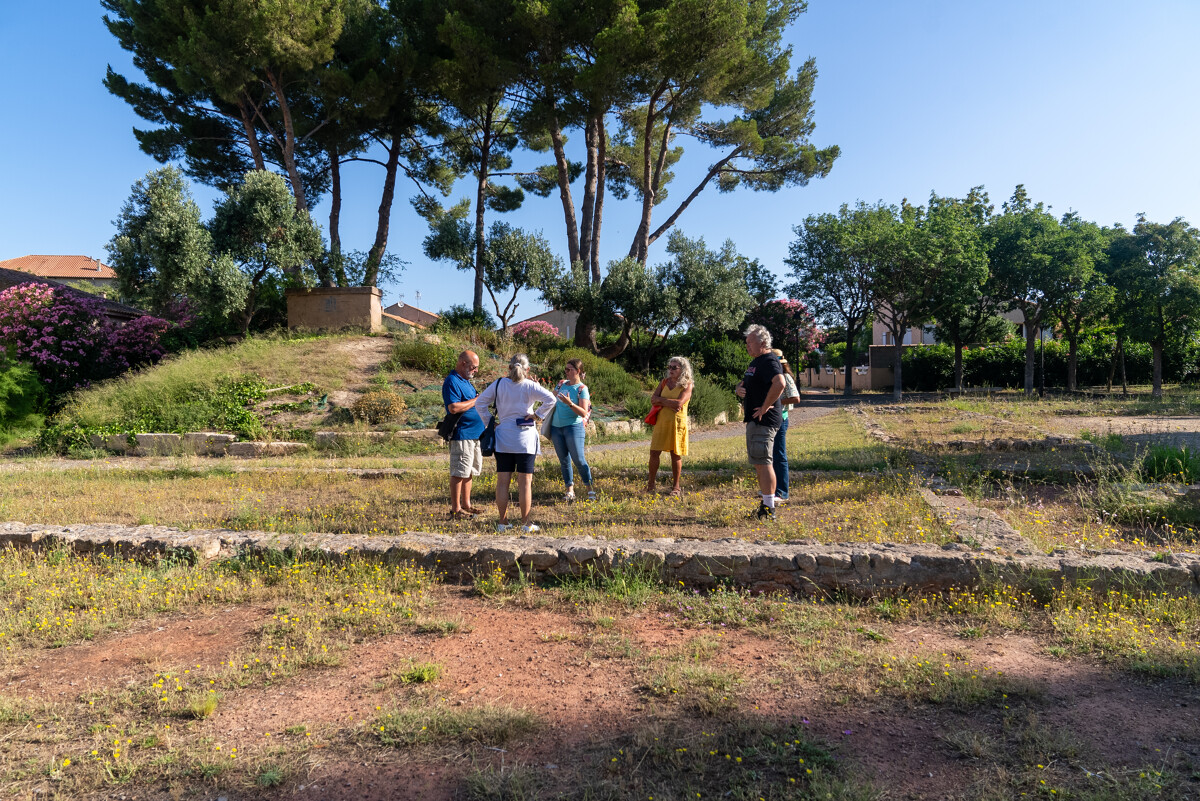
In 1987, excavation work led to the discovery of remains belonging to one of the oldest churches in the department. It was built in the early 5th century, at a time when the villa at Près-Bas was decorated with mosaic floors.
The 35m-long edifice was only excavated on its northern half, the other part being covered by the main road.
The nave, covered by a roof frame, is followed by a semicircular apse, possibly vaulted, set within a square chevet.
The central body, formed by the nave and apse, is lined, at least on the north side, by a series of lower annexe rooms, giving the illusion of a side aisle. These rooms are interconnected.
The larger central room gives the building the appearance of a cross-shaped floor plan. It houses a hexagonal baptismal font made of flat tile pieces assembled with lime, and covered with a waterproof plaster. This type of vat was typical of early Christian liturgy, where the catechumen, often an adult, was required to immerse fully during the baptism ceremony.
The baptistery is supported by two other buildings forming a right angle.
The first, divided into three rooms, is a bathing area for baptism preparations, unless it was built solely for the comfort of the clergy attached to the church. The northernmost room served as a furnace (praefurnium) to heat the two.
The 35m-long edifice was only excavated on its northern half, the other part being covered by the main road.
The nave, covered by a roof frame, is followed by a semicircular apse, possibly vaulted, set within a square chevet.
The central body, formed by the nave and apse, is lined, at least on the north side, by a series of lower annexe rooms, giving the illusion of a side aisle. These rooms are interconnected.
The larger central room gives the building the appearance of a cross-shaped floor plan. It houses a hexagonal baptismal font made of flat tile pieces assembled with lime, and covered with a waterproof plaster. This type of vat was typical of early Christian liturgy, where the catechumen, often an adult, was required to immerse fully during the baptism ceremony.
The baptistery is supported by two other buildings forming a right angle.
The first, divided into three rooms, is a bathing area for baptism preparations, unless it was built solely for the comfort of the clergy attached to the church. The northernmost room served as a furnace (praefurnium) to heat the two.
Destination
ÉGLISE PALÉOCHRÉTIENNE
Rue de la Grande Église
34140
LOUPIAN
GPS coordinates
Latitude : 43.4478414
Longitude : 3.6160163